Crude Jumps After U.S. Strike on Larak Island as Energy Leads a Lower Tape

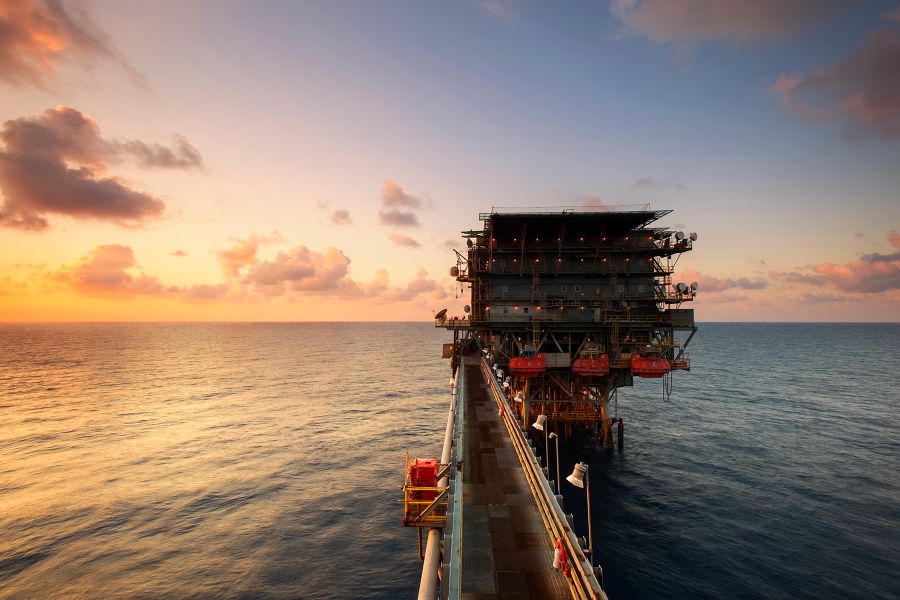
Crude oil rose sharply on Monday morning after a weekend exchange of fire between American and Iranian forces put the Strait of Hormuz back at the centre of the energy market, and U.S. equities opened the final session of August lower with energy shares the conspicuous exception.
U.S. Central Command said in a statement quoted by Yahoo Finance that "Earlier today U.S. forces struck two Iranian launchers on Larak Island," adding that "Islamic Revolutionary Guard Corps forces were observed preparing to launch rockets with sea mines into the Strait of Hormuz." OilPrice.com, reporting late Sunday, characterised the operation as what CENTCOM called a "limited, precise action against IRGC minelaying forces posing an imminent threat in the Strait of Hormuz."
Iran responded in kind. OilPrice.com reported that Iranian forces fired ballistic missiles and drones at U.S. military bases in Jordan, that the Jordanian Armed Forces intercepted eight missiles entering Jordanian airspace, and that the IRGC afterwards confirmed it had targeted technical infrastructure and aircraft at two Jordanian bases while warning of further responses to American strikes. Yahoo Finance additionally reported drone attacks on sites in Jordan and the United Arab Emirates, the seizure of a bulk carrier near Bandar Abbas, and an Iranian claim that an oil supertanker had struck a mine — a claim Yahoo Finance said U.S. Central Command disputed.
The move in the barrel
The price reaction was immediate and concentrated in crude. Writing at 8:34 a.m. ET on Monday, Yahoo Finance put Brent futures above $91 a barrel intraday, up roughly 3 per cent and through $90 for the first time in about a week, with West Texas Intermediate up roughly 4 per cent and trading above $86. OilPrice.com, publishing at 9:30 p.m. CDT on Sunday, had WTI at $85.46, up 2.47 per cent, and Brent at $90.49, up 2.71 per cent. By 10:20 a.m. ET on Monday, with the U.S. session still open, Yahoo Finance's AlphaCheck column showed the October West Texas Intermediate contract at $85.55, a gain of $2.15 or 2.58 per cent on the day.
The premium is being applied to a waterway that has already been throttled. The U.S. Energy Information Administration's August 2026 Short-Term Energy Outlook records that attacks on tankers cut flows through the Strait of Hormuz from 21.6 million barrels a day in the fourth quarter of 2025 to 4.9 million barrels a day in the second quarter of 2026. OilPrice.com reported that traffic through the waterway has fallen to roughly five vessels a day, that the UK Maritime Trade Operations issued a warning after a tanker was hit by an unidentified projectile, and that CENTCOM reported 83 commercial vessels redirected, three disabled and two boarded as of August 30.
For scale, the EIA has noted in its chokepoint analysis that oil flow through the strait averaged 20 million barrels a day in 2024, "the equivalent of about 20% of global petroleum liquids consumption," and that flows through the strait in 2024 and the first quarter of 2025 made up more than one-quarter of total global seaborne oil trade, with 84 per cent of the crude oil and condensate that transited the strait that year bound for Asian markets. The agency put available bypass capacity on the Saudi and Emirati pipelines at about 2.6 million barrels a day — a fraction of normal throughput.
How the tape traded
U.S. equities did not follow crude higher. At 10:20 a.m. ET, with more than five hours of the session still to run, Yahoo Finance's AlphaCheck reported the S&P 500 at 7,666.46, down 45.30 points or 0.59 per cent; the Dow Jones Industrial Average at 53,131.10, down 428.89 points or 0.80 per cent; the Nasdaq Composite at 26,266.12, down 136.31 points or 0.52 per cent; and the Russell 2000 at 2,951.01, down 21.36 points or 0.72 per cent. Those are intraday marks and not closing levels; the August monthly close will not be set until 4 p.m. ET.
Within that tape the sector dispersion was the story. AlphaCheck described energy as the real standout, with Chevron and Exxon Mobil benefiting from the move in crude, while utilities came under pressure, dragged by PG&E Corporation amid uncertainty over California wildfire legislation. Ahead of the open, Yahoo Finance's 8:34 a.m. ET snapshot had S&P 500 futures at 7,693.50, down 28.50 points or 0.37 per cent, the Cboe Volatility Index at 15.38, up 0.95 points or 6.59 per cent, and gold at $4,488.30, down $41.60 or 0.92 per cent.
The last completed session provides the reference point. On Friday, August 28, the S&P 500 closed at 7,711.76, down 0.25 per cent; the Nasdaq Composite at 26,402.42, down 0.52 per cent; the Dow at 53,559.99, down 0.02 per cent; and the Russell 2000 at 2,972.37, down 1.39 per cent.
A supply shock the Fed has already named
The energy channel is not incidental to monetary policy this week. The Federal Open Market Committee's statement of July 29 said inflation "remains elevated relative to the Committee's 2 percent goal, in part reflecting supply shocks that have driven price increases in certain sectors, including energy," while keeping the federal funds target range at 3-1/2 to 3-3/4 per cent on a 9-3 vote, with Beth M. Hammack, Neel Kashkari and Lorie K. Logan all preferring a quarter-point increase.
Chair Kevin Warsh returned to the theme at the Kansas City Fed's Jackson Hole symposium on August 28, where his keynote, titled "In Our Time," noted that "The recent rise in overall commodity prices also bears watching." In the same remarks he put the 12-month change in the PCE price index at 3.7 per cent and the six-month change at 4.1 per cent.
What the barrel does from here will be read against that arithmetic rather than in isolation. The EIA's August outlook, released August 11, forecasts Brent averaging $85 a barrel in the third quarter of 2026, $78 in the fourth quarter and $69 across 2027, a path that assumes traffic through the Strait of Hormuz gradually increases and shut-in production restarts. The agency's own recent price history shows how wide the distribution around that assumption has been: the Brent spot price fell as low as $69 a barrel on July 2 and reached as high as $105 on July 23.
Sources & further reading
- Yahoo Finance, "Oil prices surge higher as US and Iran exchange fire for first time in a month", published August 31, 2026, accessed August 31, 2026
- OilPrice.com, "Oil Prices Surge as U.S. and Iran Exchange Strikes", published August 30, 2026, accessed August 31, 2026
- Yahoo Finance, "Energy stocks lead in subdued final trading day of August, utilities under pressure: AlphaCheck", published August 31, 2026, accessed August 31, 2026
- U.S. Energy Information Administration, "Short-Term Energy Outlook, global oil markets", August 2026 edition, accessed August 31, 2026
- U.S. Energy Information Administration, "Amid regional conflict, the Strait of Hormuz remains critical oil chokepoint", published June 16, 2025, accessed August 31, 2026
- Board of Governors of the Federal Reserve System, "Federal Reserve issues FOMC statement", published July 29, 2026, accessed August 31, 2026
- Board of Governors of the Federal Reserve System, "Keynote remarks by Chairman Warsh at the 2026 Jackson Hole Economic Policy Symposium", published August 28, 2026, accessed August 31, 2026


